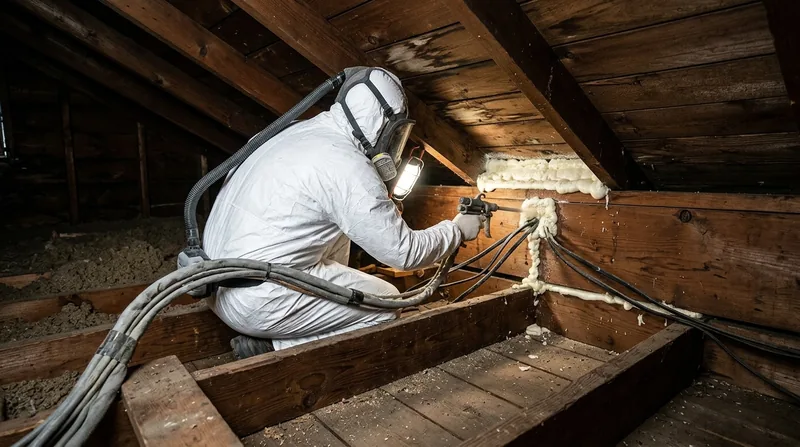




Air sealing in Minneapolis stops the stack effect that pulls heated air up through attics in winter, cutting drafts across homes in Hennepl, Ramsey and the surrounding counties. Minneapolis homes, from early twentieth-century bungalows in Northeast and Longfellow to mid-century ramblers in Richfield and St. Louis Park, sit over full basements and under attics where decades-old insulation has settled flat. Each winter, warm air rises through unsealed top plates, rim joist gaps, and penetrations around electrical boxes and ductwork, driving heating costs up and leaving cold spots along exterior walls and under eaves. Ice damming along the roofline is often the visible sign of this leak, but the real problem starts with air escaping into an uncontrolled attic space. We seal these pathways to keep conditioned air inside your home where it belongs, improving comfort and reducing the load on your heating system.
Why Air Sealing Matters in Minneapolis Homes
Minneapolis sits in IECC climate zone 6A, with long cold winters and very dry indoor air. Vapor drive runs from heated living spaces outward toward the cold exterior, which means moisture pressure builds in your walls and attic during heating season. Uncontrolled air leakage accelerates this moisture migration and allows cold air infiltration that your furnace must constantly replace. The rim joist, where the basement rim meets the foundation wall, is especially vulnerable in older block or stone foundations common across Northeast and Nokomis. When warm, moist air from living spaces reaches cold rim joist framing and concrete, condensation forms, wetting wood and creating conditions for decay. The attic floor and top plates are the second weak point, where air escapes through gaps in insulation, around ceiling penetrations, and where the wall plates meet the roof structure.
- We seal top plates where wall framing meets the attic to stop warm air from rising into unconditioned space.
- We close gaps around electrical boxes, plumbing vents, and ductwork penetrations that act as direct conduits for air movement.
- We air seal rim joists and band joists to prevent cold air infiltration and moisture intrusion at the basement rim.
- We identify and seal wall cavities where existing insulation has settled or shifted, leaving voids that leak air.
- We use spray foam as the primary air sealing medium because it expands to fill irregular gaps and adheres to wood, concrete, and metal.
Proper air sealing is the foundation of any insulation retrofit, and it is the single biggest differentiator between a spray foam installation and a fiberglass or blown-in job.
Key info: Ice damming in Edina, St. Louis Park, and Bloomington is often blamed on roof design or shingle failure. The real culprit is usually warm air escaping through an unsealed attic floor and rim joist. Sealing these leaks stops the heat loss that melts snow on the roof, which then refreezes at the cold eaves.
For more detail on the connection between air sealing and insulation performance, see our attic spray foam insulation service page.
Minnesota 811 requires utility locates before any excavation, though air sealing work typically does not involve ground disturbance. Permitting requirements vary by city, so we help you understand what applies at your address and coordinate with your local building department. For Minneapolis and St. Paul, contact the city building inspector early if you plan major attic or rim joist work.
How We Air Seal Homes in Minneapolis
Our air sealing process starts with a walk-through inspection of your attic, basement rim, and any walls marked for retrofit. We identify the primary air leakage pathways, measure the scope of work, and specify the type of foam (closed cell or open cell) based on your climate zone, moisture risk, and budget. Closed cell foam is denser, provides higher R-value per inch, and offers better moisture resistance, making it the standard choice for rim joists and attic edges in Minneapolis where vapor drive is strong. Open cell foam is lighter, more flexible, and suitable for interior wall cavities where moisture can dry to the interior. We apply foam at the correct thickness and ratio, maintain controlled drum temperature, and ensure mechanical ventilation during cure to manage VOCs. Re-entry is typically twenty-four to forty-eight hours after application, and we provide written specifications for R-value and thickness on every estimate.
- We inspect the attic floor, top plates, and all penetrations to map air leakage and identify the best sealing strategy.
- We remove debris and moisture from surfaces before foam application to ensure proper adhesion and curing.
- We spray foam at the manufacturer-specified ratio and drum temperature, applying multiple passes to achieve target thickness without voids.
- We operate mechanical ventilation during cure to reduce VOC exposure and allow the foam to cure safely.
- We trim excess foam flush with the surface and leave the space ready for additional insulation or drywall as needed.
The entire process is documented with before and after photos and a written report showing R-value and thickness at each location.
Example: A 1960s rambler in Richfield with a vented attic and a full basement had chronic condensation on the rim joist each winter. The basement walls were block, cold, and the rim framing was damp. We sealed the rim joist with two inches of closed cell foam, sealed the band joist to the foundation top, and sealed around rim joist penetrations for plumbing and electrical. The condensation stopped, and the homeowner noticed warmer basement corners by the next heating season.
For details on how air sealing pairs with closed cell spray foam insulation, see our closed cell service page.
Air Sealing Methods and Approaches
| Approach | Description | Best For |
|---|---|---|
| Closed Cell Foam Sealing | Two-component polyurethane foam sprayed at high pressure, expanding to fill voids and curing to a rigid shell in minutes. Density 2 to 3 pounds per cubic foot, R-value 6.5 to 7.0 per inch. Moisture resistant and does not absorb water. | Rim joists, band joists, basement walls, attic edges, and any location where moisture risk is high or space is tight. Standard for Minneapolis climate zone 6A. |
| Open Cell Foam Sealing | Lower density polyurethane foam, 0.5 to 1.0 pounds per cubic foot, R-value 3.5 to 4.0 per inch. Softer, more flexible, and allows vapor transmission. Cures in hours. | Interior wall cavities in pre-war duplexes, stud bays, and attic top plates where moisture can dry to the interior and higher R-value per inch is not critical. |
| Attic Floor Penetration Sealing | Spray foam applied around electrical boxes, recessed lights, ductwork, plumbing vents, and other protrusions through the attic floor. Sealed penetrations stop air leakage and allow insulation to rest evenly. | Any attic retrofit where existing insulation is to be removed and replaced, or where insulation has settled around penetrations. |
| Top Plate and Rim Joist Sealing | Foam applied along the full length of the top plate where the wall meets the attic, and along the rim joist where the wall frame meets the foundation. Seals the primary air leakage pathway in stack effect-driven homes. | Every Minneapolis home with an attic and basement. This is the single most cost-effective air sealing measure in climate zone 6A. |
Each method is chosen based on the moisture risk, temperature difference, and access at that location. We specify the method and thickness in writing before work begins.
Air Sealing Cost in Minneapolis: What to Expect
Air sealing costs in Minneapolis start at around $650 for a small attic top plate or single rim joist section, and scale upward based on the linear footage of rim joist, the number of attic penetrations, and the complexity of access. A typical full attic air sealing job on a rambler or Cape Cod, including top plates, rim joists, and penetration sealing, runs $1,200 to $2,500. Larger homes, multi-story structures, or jobs requiring scaffolding or exterior wall access cost more. We measure the work on site, specify the foam type and thickness, and provide a written estimate before any spray begins.
The main factors that move the price are the linear footage of rim joist and top plate, the number of penetrations to seal, whether existing insulation must be removed first, and the ease of access to the attic or basement. A finished basement or attic with limited crawl space adds time and cost. A home with vented eaves or soffit vents that need sealing adds area. We always recommend getting 2 to 3 estimates from different contractors so you can compare scope, foam type, thickness, and warranty. Avoid any estimate that does not specify R-value and thickness, or that promises a price far below market without a detailed site inspection.
For a full breakdown of our pricing across all services, visit our pricing page. Call us at (612) 441-5734 for a free estimate, or fill out our contact form and we will respond within 24 hours.
What to Look for When Hiring an Air Sealing Contractor Near Minneapolis
Air sealing is not a licensed trade in Minnesota, so there is no state registration or bonding requirement specific to spray foam work. That means the burden falls on you to verify that any contractor is fully insured and carries general liability coverage for spray foam application. Ask to see the certificate of insurance, confirm it covers spray foam work, and verify the policy is current. Ask for references from recent jobs in your neighborhood, and call 2 to 3 of them to ask about the quality of the seal, the smell during and after cure, and whether the contractor was reachable if questions came up after the job.
- Verify the contractor is fully insured for spray foam work and can provide a current certificate of insurance naming your address as additional insured.
- Ask for a written estimate that specifies the foam type (closed cell or open cell), R-value per inch, thickness at each location, and the total board feet of foam.
- Check that the estimate includes mechanical ventilation during cure and a stated re-entry window of twenty-four to forty-eight hours.
- Confirm the contractor will remove old or failed insulation before sealing, and will not spray over wet, moldy, or contaminated substrate.
- Ask whether permits are required at your address and who will pull them. Permitting varies by city, so the contractor should help you navigate local rules, not promise to handle everything.
- Get references from at least two recent jobs in Minneapolis, St. Paul, or Bloomington, and call them to ask about the quality of work and the contractor's responsiveness after the job.
The cheapest estimate is rarely the best. A contractor who shows up with no inspection, quotes a price far below market, and promises immediate re-entry is cutting corners on ventilation, ratio, or thickness. The strongest indicator of quality is a detailed written estimate, a site inspection, and a clear explanation of why the job costs what it costs.
Contact us at (612) 441-5734 or visit our contact page to request a free estimate. We inspect every job on site, provide written specifications, and stand behind our work with a one-year workmanship warranty.
Air Sealing in Minneapolis: Pricing Guide
| Service | Price | Details |
|---|---|---|
| Attic top plate and rim joist sealing | Starting at $650 | Includes foam application along top plates and rim joists, sealed penetrations, mechanical ventilation during cure |
| Full attic air sealing retrofit | Starting at $1,200 | Includes top plates, rim joists, all floor penetrations, and removal of existing failed insulation if needed |
| Basement rim joist sealing | Starting at $800 | Includes closed cell foam on rim joist, band joist, and foundation top, with moisture barrier and sealed penetrations |
| Wall cavity air sealing retrofit | Starting at $1,500 | Includes injection foam or open cell spray foam in pre-war wall cavities, sealed at top and bottom plates |
| Large or complex job | On estimate | Multi-story homes, commercial buildings, or jobs requiring scaffolding or exterior access need on-site inspection |
| Free estimate | No charge | Response within 24 hours, includes site inspection, written specifications with R-value and thickness, no obligation |
Indicative pricing, the exact cost depends on square footage, finish, and site access. Free personalized estimate within 24h at (612) 441-5734.


