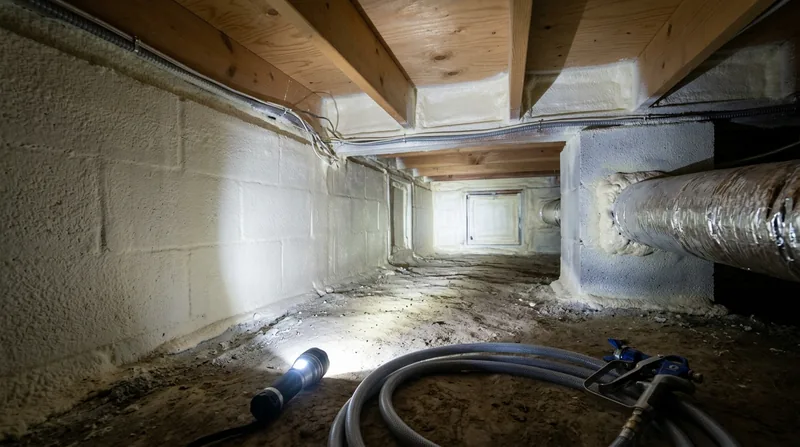




Minneapolis crawl spaces under mid-century ramblers and older homes across Richfield, St. Louis Park, Edina and Bloomington trap cold, damp air that leaks into living spaces above. Crawl space spray foam insulation seals the walls and band joist area to block moisture infiltration and cut cold floors that drive heating bills up every winter. The rim joist where the foundation meets the house frame is where seasonal moisture and condensation risk are highest in IECC climate zone 6A. We foam crawl space walls and the band joist with closed cell or open cell spray foam to shut out cold air, reduce moisture, and stabilize floor temperatures. This is one of the three biggest energy weak points in the Twin Cities, alongside leaky attics and uninsulated walls in older Northeast duplexes.
Why Crawl Space Spray Foam Insulation Matters in Minneapolis Homes
Cold crawl spaces under Minneapolis ramblers pull heat from the floors above and allow moisture-laden outside air to seep in through rim joists and foundation cracks. Winter cold from an uninsulated crawl space travels straight up through the floor cavity, making living rooms feel drafty even when the heating system is running. The seasonal moisture swing in Minnesota, from dry indoor air in winter to humid summer storms, drives condensation risk at the band joist and crawl space walls where cold meets warm. Spray foam blocks both air leakage and vapor transmission, so cold floors warm up and moisture stays out.
- Uninsulated crawl space walls allow cold outdoor air to enter the band joist area and seep into living spaces above.
- Moisture from the soil and seasonal humidity condenses at the rim joist where the foundation meets the house frame.
- Spray foam on crawl space walls and the band joist stops cold air leakage and blocks moisture vapor from entering the house.
- Sealed crawl spaces lower floor temperatures and reduce the heating load the furnace must carry through winter.
Crawl space insulation is one of the highest-return energy upgrades in Minneapolis because the payoff is immediate and the failure mode is visible: cold floors disappear within days of foam installation.
Key info: Minneapolis and Hennepin County homes built in the 1950s through 1980s sit over crawl spaces with exposed block or stone foundations and uninsulated rim joists. These are the exact conditions where cold floors and condensation risk are highest. A rambler in Richfield or Edina with a cold, damp crawl space loses heat constantly through the floor cavity and the band joist.
For more detail on how air sealing works alongside insulation, see our page on air sealing in Minneapolis.
Minnesota's Department of Labor and Industry provides guidance on contractor registration requirements at dli.mn.gov, which varies by city and service type.
How We Insulate Crawl Spaces in Minneapolis: The Process
Crawl space spray foam insulation starts with a site visit to assess access, existing conditions, and moisture risk. We inspect the rim joist, foundation walls, and soil conditions to determine whether the crawl space can be foamed immediately or whether standing water or active leaks must be addressed first. Once the space is dry and ready, we seal air leaks at the band joist and spray foam on the interior crawl space walls to create a continuous thermal and moisture barrier. The job typically takes one day for a standard crawl space, and the space is ready for normal use after the foam has cured, usually within 24 to 48 hours.
- We inspect the crawl space for moisture, standing water, and access points to determine the scope of work.
- We identify and seal air leaks at the rim joist, band joist, and any foundation penetrations before foaming begins.
- We spray closed cell or open cell foam on the interior crawl space walls to the specified thickness and R-value.
- We apply a thermal barrier or ignition barrier if required by the Minneapolis building code at your address.
- We verify coverage, thickness, and density before the crew leaves and provide written documentation of the R-value and board feet applied.
The entire process is controlled and documented so you know exactly what was installed and why.
Example: A 1960s rambler in Edina with a 900-square-foot crawl space under the main floor typically requires 2 to 3 inches of closed cell foam on the walls and band joist area. The job takes one full day, the space cures overnight, and cold floors are noticeably warmer within a week as the heating system runs less.
Learn more about closed cell spray foam insulation and its moisture control benefits.
Crawl Space Spray Foam Methods: Closed Cell vs. Open Cell
| Method | Description | Best For |
|---|---|---|
| Closed Cell Spray Foam | High-density foam that cures rigid and impermeable to moisture and air. Typical thickness 2 to 3 inches. R-value approximately 6.5 per inch. | Crawl spaces with moisture risk, rim joists, band joists, and any space where vapor control is critical. |
| Open Cell Spray Foam | Lower-density foam that is permeable to vapor and slightly softer. Typical thickness 5 to 7 inches for equivalent R-value. R-value approximately 3.5 to 4 per inch. | Crawl spaces in dry climates or where cost is the primary driver and moisture risk is low. Not recommended for Minneapolis rim joists. |
| Closed Cell on Walls, Open Cell in Rim Joist | Hybrid approach using closed cell on foundation walls (moisture barrier) and open cell in the rim joist cavity for air sealing and sound dampening. | Crawl spaces where budget is moderate and the rim joist is the primary air leak point. |
| Spray Foam Over Existing Insulation | Adding a layer of spray foam to existing fiberglass or mineral wool in the crawl space to improve air sealing and R-value. | Retrofit jobs where existing insulation is in place but air leakage is the primary problem. |
Closed cell is the standard choice for Minneapolis crawl spaces because the seasonal moisture swing and foundation condensation risk demand a vapor barrier. Open cell is less expensive but offers no moisture control and is rarely the right answer in zone 6A.
Crawl Space Spray Foam Insulation Cost in Minneapolis: What to Expect
Crawl space spray foam insulation in Minneapolis typically starts at $2,500 for a small to mid-sized space under a rambler or bungalow. The final cost depends on the square footage of walls to be foamed, the thickness and R-value specified, whether the space is dry and accessible, and whether the rim joist is included in the scope. A typical 800 to 1,000 square foot crawl space with closed cell foam on the walls and band joist usually runs $3,500 to $5,500 before any insulation removal or structural repairs. Getting two or three written estimates from local contractors with R-value and thickness specifications is the only way to compare apples to apples.
Factors that move the cost up include difficult access (low headroom, narrow crawl space), standing water or active moisture that must be addressed first, removal of old insulation, and the need for a thermal barrier under the floor decking. Factors that keep costs down include good access, a dry crawl space, and a straightforward rim joist with no obstructions. Our written estimates always include the R-value, thickness in inches, the board feet of foam to be applied, and the labor scope so you understand exactly what you are paying for.
See our full pricing overview for detailed ranges across all crawl space and band joist work.
What to Look for When Hiring a Crawl Space Spray Foam Contractor Near Me in Minneapolis
Hiring the right spray foam contractor is the difference between a job done right and one that leaves you with odor, poor adhesion, or missing coverage. A reputable local contractor will show up on time with a written estimate that includes R-value and thickness, perform the work with mechanical ventilation during cure, and be reachable after the job if questions arise. Avoid any contractor who quotes a price without seeing the crawl space, promises immediate re-entry, or cannot provide proof of current insurance.
- Verify that the contractor is fully insured and can provide a certificate of insurance naming you as an additional insured.
- Ask for a written estimate with R-value per inch, total thickness, total board feet, and the labor timeline before work begins.
- Request references from recent crawl space jobs in Minneapolis or nearby suburbs and call at least two of them.
- Confirm that the contractor will use mechanical ventilation during foam cure and provide a realistic re-entry window of 24 to 48 hours.
- Check that the contractor understands local permitting rules for your city, since requirements vary across Minneapolis, St. Paul, Bloomington, and other suburbs.
- Ask whether the contractor will walk away if the crawl space has standing water or active leaks, and what the moisture remediation plan is.
A contractor who insists on fixing moisture first or walking away is signaling that they understand the trade and will not spray foam into a failing condition.
Call us at (612) 441-5734 for a free estimate and to discuss your crawl space condition. Contact us online anytime with photos or questions.
Crawl Space Spray Foam Insulation in Minneapolis: Pricing Guide
| Service | Price | Details |
|---|---|---|
| Small crawl space (under 500 sq ft walls) | Starting at $2,500 | Closed cell foam 2 to 3 inches on walls and band joist, includes mechanical ventilation and written documentation |
| Standard crawl space (500 to 1,200 sq ft) | Starting at $3,500 | Closed cell spray foam on foundation walls and rim joist, typical rambler or bungalow scope, labor and materials included |
| Large or complex crawl space | On estimate | Difficult access, moisture remediation required, or extensive rim joist work requires on-site inspection before pricing |
| Insulation removal plus spray foam | Add $500 to $1,500 | Removal of old fiberglass or mineral wool from crawl space before new foam applied, depends on volume and disposal |
| Travel and estimate | Free | No mileage fee in Minneapolis and surrounding suburbs, free written estimate with 24-hour response at (612) 441-5734 |
Indicative pricing, the exact cost depends on square footage, finish, and site access. Free personalized estimate within 24h at (612) 441-5734.


