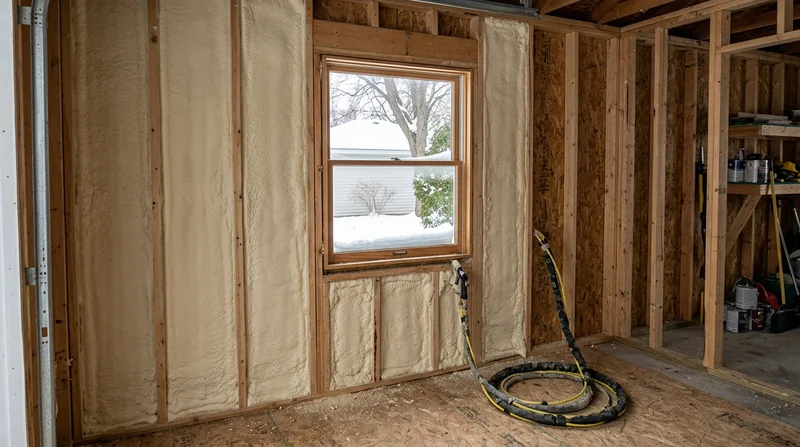




A detached garage in Minneapolis is an asset only if you can use it year-round. Without insulation, the space stays bitterly cold from November through March, making it a place to park and leave, not to work or spend time. Garage spray foam insulation changes that. We spray the stud bays in the walls and the ceiling joists with closed or open cell foam, sealing air leaks as we go, so your garage stays usable through a Minnesota winter without running a space heater that costs more than the heating itself. This is the work of a local insulation shop with the right equipment, the right material ratios, and the discipline to ventilate the space properly during cure. We've been doing this since 2010 across Minneapolis, St. Paul, Bloomington, Edina, and the surrounding counties.
Why Garage Insulation Matters in the Twin Cities Cold
Minneapolis winters push temperatures to 15, 10, even minus 5 degrees Fahrenheit. An uninsulated garage wall is thin plywood or drywall over an open stud cavity. Heat from the house bleeds through the shared wall. The ceiling, if it's just drywall and joists, acts like a chimney, pulling warm air up and out. The result is a garage that stays near outdoor temperature, making it unusable for a workshop, hobby space, or even a comfortable place to work on a car on a cold afternoon. The frost line in Hennepin and Ramsey counties sits three to four feet below grade, so the rim joist and band board of a garage foundation are perpetually cold, and any air leakage there pulls conditioning out of the house next to it.
- An uninsulated garage ceiling loses heat directly to the attic and outdoors, making the space unusable without supplemental heating.
- Shared walls between a garage and the house allow conditioned air to escape, raising your heating bills even if you never use the garage.
- Cold garage air seeping into the house through gaps and penetrations reduces comfort and forces your furnace to work harder.
- Spray foam seals the stud cavities completely, stopping both conductive heat loss and air infiltration in a single pass.
- An insulated garage is warm enough to work in, store sensitive items, or park a vehicle without ice accumulation on the windshield.
The Minneapolis building code and the Minnesota energy code set minimum R-values for garage insulation based on climate zone 6A. We help you navigate what applies to your address and ensure the job meets code.
Key info: A garage in St. Louis Park or Edina with an uninsulated ceiling and shared wall to the house is losing 20 to 30 percent of the heating energy needed to keep the adjacent living space warm. Spray foam stops that leak and pays for itself over time.
For more on the technical side of insulation, see our page on closed cell spray foam insulation, which is the standard choice for garage walls and ceilings because it handles condensation and provides the highest R-value per inch.
How We Insulate a Garage: The Minneapolis Process
The job starts with a walk-through and an estimate that includes the R-value we'll hit, the foam thickness in each cavity, and the total board feet. We measure the ceiling, the exterior walls, and any shared walls with the house. We identify rim joists, electrical penetrations, and any moisture or damage that needs attention before foam goes down. If there's old insulation or debris, we remove it first. We then set up mechanical ventilation to manage fumes during the spray and cure period, which typically runs 24 to 48 hours before the space is safe to re-enter.
- We inspect the garage structure and identify any existing insulation, moisture damage, or air gaps that need sealing.
- We remove old insulation or debris if present, leaving a clean substrate for foam adhesion.
- We set up mechanical ventilation fans to pull fumes out during spraying and the initial cure phase.
- We spray closed or open cell foam to fill the stud cavities and ceiling joists, working methodically to achieve consistent thickness and R-value.
- We apply a thermal barrier (typically a fire-rated coating or drywall) over the foam to meet code and protect it from UV and damage.
- We provide a re-entry window of 24 to 48 hours before you use the space, and we confirm ventilation before we leave.
Once the foam cures, the garage stays warm, quiet, and free of drafts. You can work comfortably, park without condensation on the windshield, and the heating load on your house drops noticeably.
Example: A detached two-car garage in Bloomington with a 400-square-foot ceiling and 300 square feet of exterior wall typically runs 800 to 1,000 board feet of closed cell foam at 2 inches thick, hitting R-13 to R-16 per inch. That job takes one day, with 24 to 48 hours cure time before the space is usable.
If you're also concerned about the attic or crawl space, see our full service on attic spray foam insulation and crawl space spray foam insulation.
Spray Foam Methods for Garage Insulation
| Approach | Description | Best for |
|---|---|---|
| Closed Cell Spray Foam | High-density foam with an R-value of 6.0 to 7.0 per inch, providing excellent air sealing and moisture resistance. Cures rigid and strong. | Garage ceilings and exterior walls where R-value density and condensation control are priorities. Standard choice for Minnesota cold. |
| Open Cell Spray Foam | Lower-density foam with an R-value of 3.5 to 3.8 per inch, softer and more flexible. Excellent for air sealing and sound dampening. | Garage interiors where sound reduction is valued and condensation risk is low. Requires thicker application to match closed cell R-value. |
| Partial Fill with Closed Cell | Spray 1 to 1.5 inches of closed cell in the stud cavity to create an air barrier, then top up with open cell or blown-in to meet total R-value at lower cost. | Budget-conscious garages where the closed cell air seal is the priority and total R-value can be achieved with a hybrid approach. |
| Ceiling-Only Spray Foam | Insulate the garage ceiling joists only, leaving walls unsprayed. Reduces heat loss through the roof but does not address shared wall leakage. | Garages where the shared wall is already insulated or where budget limits the scope to the highest heat loss area (the ceiling). |
Garage Spray Foam Insulation Cost in Minneapolis: What to Expect
The cost of garage spray foam insulation in Minneapolis starts at around $1,200 for a smaller single-car garage with a limited scope, typically a ceiling-only job. A full two-car garage with walls and ceiling, closed cell foam, and a thermal barrier usually runs between $2,500 and $4,500, depending on the total square footage, foam type, and whether old insulation needs removal. The primary factors that move the price are the total board feet of foam required, the choice between closed and open cell, the complexity of the space (vaulted ceilings, complex geometry, many penetrations), and access for the spray equipment.
If your garage has an uninsulated shared wall with the house, that wall is part of the estimate because it's part of the heating loss. If the ceiling is the only uninsulated surface, the job is smaller and cheaper. Many homeowners in Plymouth, Edina, and Maple Grove find that adding the walls to the scope is worth it because the shared wall is where the house is losing the most conditioning.
We provide a written estimate with R-value and thickness specifications so you know exactly what you're getting. The estimate is free, and we'll respond within 24 hours. If you want to compare, get two or three estimates from other contractors so you can see the differences in foam type, R-value, and price. See our full pricing overview for more detail on what drives the cost.
One note on budget: a garage insulation job is often the entry point to a larger retrofit. If you're also thinking about the attic or crawl space, ask us about bundling the jobs, which can reduce the per-board-foot cost and the total time on site.
Garage Spray Foam Insulation Near Me: What Minneapolis Homeowners Should Know Before Hiring
When you're looking for a spray foam contractor in Minneapolis, Woodbury, Coon Rapids, or any of the surrounding areas, there are several things to verify before you sign a contract. First, confirm that the contractor is fully insured and can provide a certificate of insurance. Ask for references from recent garage jobs in your area, and call at least two of them. A good contractor will be happy to share work and answer questions about how the job went and whether any issues came up after completion.
Second, get a written estimate that includes the R-value per inch, the thickness of foam in each cavity, the total board feet, and the foam type (closed or open cell). If the estimate doesn't include these details, walk away. A vague estimate with no R-value and no thickness is a red flag for poor workmanship or a bait-and-switch price later.
Third, ask about permits. In Minneapolis and most surrounding cities, garage insulation does not require a permit if it's a detached structure. But if your garage is attached to the house or if you're in a city with stricter rules, permits may apply. A contractor who doesn't ask about your address and your local code is not doing due diligence. We help you navigate what applies at your address and coordinate with the city if needed.
Fourth, if your garage is in a homeowners association (HOA) community, check the architectural guidelines before you start. Most HOAs don't regulate interior insulation, but some do have rules on exterior work or material changes. A quick call to the HOA or a review of the covenants takes five minutes and saves headaches later.
Finally, ask about ventilation during cure and the re-entry window. A contractor who promises you can use the space immediately after spraying is not following best practice. Proper cure takes 24 to 48 hours with mechanical ventilation running. That's the sign of a professional shop, not a rig-and-run crew.
We're a local Minneapolis insulation contractor with a local address and a track record since 2010. If you're ready to move forward, contact us for a free estimate or call (612) 441-5734.
Garage Spray Foam Insulation in Minneapolis: Pricing Guide
| Service | Price | Details |
|---|---|---|
| Single-car garage ceiling only | Starting at $1,200 | Ceiling joists insulated with closed cell foam to R-16, 24-hour cure, no wall work included |
| Two-car garage, ceiling and walls | Starting at $2,500 | Full ceiling and exterior wall cavities, closed cell foam, thermal barrier, 24 to 48 hour cure window |
| Garage with shared wall and old insulation removal | Starting at $3,200 | Ceiling, exterior walls, shared wall with house, removal of existing insulation, closed cell foam, thermal barrier |
| Complex or large garage, vaulted ceilings, multiple penetrations | On estimate | Scope and board footage determined on site; we provide written estimate with R-value and thickness specs before work begins |
| Travel and setup | Included | No separate mileage or travel fee for Minneapolis, St. Paul, Bloomington, and surrounding service areas |
| Estimate | Free | Response within 24 hours at (612) 441-5734, no obligation to book, written estimate with specifications included |
Indicative pricing, the exact cost depends on square footage, finish, and site access. Free personalized estimate within 24h at (612) 441-5734.


