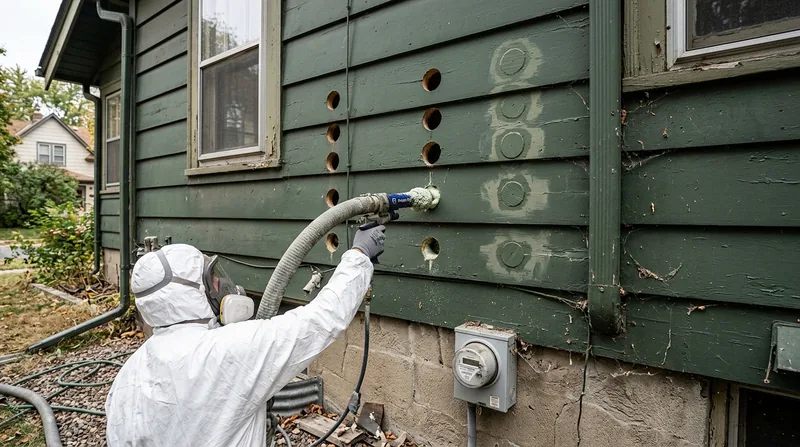




Older Minneapolis homes in Northeast, Longfellow, and around the Chain of Lakes were built with hollow wall cavities that were never insulated. These uninsulated stud bays sit behind plaster, brick, and original siding, and they leak heat every winter without opening a wall or tearing off the facade. Wall and injection foam insulation fills those cavities from the outside using small access holes, delivering R-value where it matters most without demolition. We inject foam into the stud bays, seal the holes, and patch the exterior to match your siding. For pre-war duplexes and early twentieth-century bungalows across Hennepin and Ramsey counties, injection foam is the only retrofit that works without gutting the interior.
Why Wall Injection Foam Matters in Minneapolis Older Homes
Minneapolis stock built before 1950 was framed with hollow walls and no cavity insulation. Winter heating escapes through these empty stud bays at a steady rate, and the colder the season, the larger the loss. A pre-war bungalow in Northeast with uninsulated walls can lose 20 to 30 percent of its heating energy through the exterior walls alone. Injection foam stops that loss without requiring you to live through wall removal, plaster repair, or exterior demolition.
- Fills hollow cavities in stud bays without opening walls or removing siding.
- Seals air leaks at the same time the foam expands into gaps and cracks.
- Delivers R-value between 3.5 and 4.0 per inch depending on foam type and density.
- Covers entire wall sections in a single day without interior disruption.
- Works on brick, plaster, wood siding, and aluminum without damage to finishes.
Injection foam is the retrofit answer for Minneapolis homes where the walls are the weak point and the structure cannot be opened.
Local example: A 1920s duplex in Northeast Minneapolis with 8-inch brick exterior and plaster interior walls had no cavity insulation. Injection foam was drilled through the brick in a line of 1-inch holes spaced 16 inches on center, foam was injected into each bay, and the holes were patched to match. The entire west-facing wall was completed in one day. The homeowner kept all interior finishes intact and gained R-14 to R-16 in the walls without living elsewhere during the work.
For guidance on permits and building code compliance in your Minneapolis neighborhood, contact the City of Minneapolis Licenses and Permits division to confirm what applies at your address.
How Wall Injection Foam Insulation Works in Minneapolis Homes
The injection process begins with a site assessment to locate stud bays, identify any obstructions, and determine the best access points. We drill small holes (typically 1 inch) through the exterior facade at intervals that align with the stud spacing. The foam is injected under controlled pressure into each cavity, expands to fill the space, and cures in place. Once cured, the holes are patched with foam-compatible sealant, caulk, or mortar to match your exterior finish. For masonry, we use color-matched mortar; for siding, we patch and paint or stain to blend.
- Drill access holes through the exterior at stud bay intervals, typically 16 inches on center.
- Inject closed-cell or open-cell foam into each cavity under measured pressure and flow rate.
- Allow foam to cure for 24 to 48 hours before patching or re-exposing the wall.
- Patch all holes with sealant, caulk, or mortar matched to your existing exterior material.
- Inspect each bay for complete fill and address any voids before final closure.
The entire process avoids interior disruption, preserves your plaster and original trim, and requires no HVAC or electrical rework. When combined with air sealing at penetrations and rim joists, wall injection delivers measurable heating cost reduction in older Minneapolis homes.
Real Minneapolis scenario: A 1930s home in St. Louis Park had uninsulated 2x4 exterior walls and single-pane windows. The homeowner was unwilling to replace the original plaster interior or remove the brick facade. Injection foam was applied to the north and west walls (the most exposed faces), with drilling done from the exterior only. Holes were patched with color-matched mortar. Combined with rim joist foam in the basement, the heating bill dropped by 18 percent in the first winter.
Injection Foam Methods and Best Applications
| Method | Description | Best For |
|---|---|---|
| Closed-Cell Injection | High-density foam with R-6.5 per inch, minimal expansion, rigid when cured. Requires precise metering and controlled injection pressure. | Masonry walls, tight cavities, walls where moisture control is critical, exterior-facing walls in IECC Zone 6A climates. |
| Open-Cell Injection | Lower-density foam with R-3.5 per inch, expands more freely, softer when cured. Allows vapor transmission and is easier to drill or cut if future access is needed. | Interior walls, non-structural cavities, retrofit jobs where cost is primary, walls where future access to utilities is likely. |
| Multi-Pass Injection | Multiple injection points per stud bay to ensure complete fill and eliminate voids. Requires more access holes but guarantees coverage in deep or obstructed cavities. | Older homes with settled debris or blocking in cavities, walls over 10 feet tall, walls with diagonal bracing or fire blocking. |
| Pressure-Monitoring Injection | Real-time pressure feedback during injection to detect voids, obstructions, or over-fill before curing. Technician adjusts flow and stops when back-pressure indicates full cavity. | Any retrofit job where quality assurance is non-negotiable, walls with unknown interior conditions, high-value or historic homes. |
Closed-cell foam is the standard for Minneapolis exterior walls because it delivers higher R-value per inch, resists moisture in our cold-winter climate, and provides structural support to the wall assembly. Open-cell is chosen when cost is the primary driver or when the wall is interior-facing and moisture is not a concern. We specify the method based on your wall orientation, existing conditions, and heating goals.
Wall and Injection Foam Insulation Cost in Minneapolis: What to Expect
Wall injection foam is priced per square foot of wall area treated, with most Minneapolis jobs ranging from $2.00 to $3.50 per square foot depending on foam type, wall height, access difficulty, and the complexity of patching. A typical pre-war duplex with 1,200 square feet of uninsulated exterior wall (two stories, 20 feet wide, 30 feet long) will cost between $2,400 and $4,200 for closed-cell injection with patching included. Open-cell runs $1.50 to $2.50 per square foot and is chosen when budget is tight and the wall is not moisture-critical.
Cost factors that move the estimate up include: masonry walls (brick or stone) that require mortar patching; walls over 20 feet tall requiring scaffolding or lift access; cavities obstructed by settling, old insulation, or wiring that require multi-pass injection; and exterior finishes (stucco, specialty siding) that demand color-matched patching. Accessibility matters: a street-facing wall in Longfellow is faster than a wall in a tight alley or against a neighbor's structure. Travel is included in our service area, so there is no separate mileage charge.
We provide a written estimate with R-value and thickness specifications after a site visit. The estimate includes the foam type, injection points, patching method, and a realistic timeline. Get 2 to 3 estimates from local contractors so you can compare not just price but approach, warranty, and the contractor's willingness to answer questions about foam type and curing conditions. For a detailed pricing breakdown and current rates, visit our pricing page.
Wall and Injection Foam Insulation Near Me: What Minneapolis Homeowners Should Know When Hiring
When you are looking for a spray foam contractor in Minneapolis or the surrounding suburbs, verify that they are fully insured and carry general liability and workers compensation coverage. Ask to see the certificate of insurance before any work begins. A legitimate contractor will provide a written estimate with R-value, thickness, foam type, and a curing timeline. Be wary of any estimate with no specifications, a price far below market, or a promise of immediate re-entry; those are markers of cut-corner work.
Request references from recent jobs in your neighborhood, and contact at least two to ask about the quality of the patch work, the curing smell, and whether the contractor was reachable if questions arose after the job. Understand what permits, if any, apply at your address by calling the local building department; most wall injection work does not require a permit, but some Minneapolis neighborhoods have architectural review boards that may require notification if the exterior is being drilled. Ask your contractor to confirm what applies to your property before any work begins.
Check whether the contractor is willing to discuss foam type, injection pressure, and curing conditions before work starts. A contractor who can explain why closed-cell is better for your north-facing masonry wall, or why open-cell makes sense for an interior wall, is demonstrating the expertise that separates a local operator from a rig-and-run crew. Ask about the mechanical ventilation during cure: proper cure requires fresh air movement, and a contractor who promises immediate re-entry is cutting the cure time short.
For a free, no-obligation estimate from a Minneapolis contractor with local experience in older homes, contact us or call (612) 441-5734. We are available for estimates within 24 hours and can answer any questions about how wall injection foam works in your specific home.
Wall & Injection Foam Insulation in Minneapolis: Pricing Guide
| Service | Price | Details |
|---|---|---|
| Closed-Cell Wall Injection | Starting at $2.50/sq ft | High-density foam with R-6.5 per inch, best for masonry and moisture-critical walls, includes patching |
| Open-Cell Wall Injection | Starting at $1.75/sq ft | Lower R-value but cost-effective for interior walls and retrofit budgets, includes patching and caulk |
| Multi-Pass or Complex Retrofit | On estimate | Walls with obstructions, settling, or deep cavities require site assessment before firm pricing |
| Travel and Setup | Included | No separate mileage or travel fee within Minneapolis and surrounding service area |
| Free Estimate | No obligation | Written estimate with R-value, thickness, and patching method, response within 24 hours |
Indicative pricing, the exact cost depends on square footage, finish, and site access. Free personalized estimate within 24h at (612) 441-5734.


