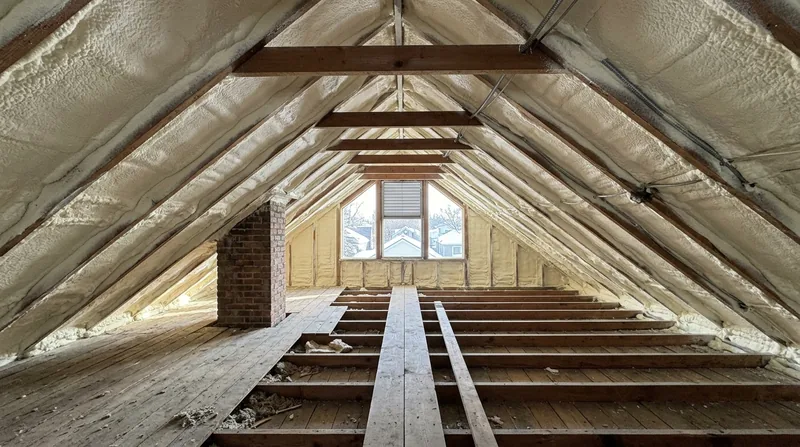




Minneapolis attics are a study in seasonal failure. Across Northeast bungalows, Longfellow duplexes, and mid-century ramblers in Richfield and St. Louis Park, decades-old fiberglass insulation has settled flat, losing R-value and leaving the attic floor cold. Every winter, warm air from the living space rises through the attic, melts snow on the roof edge, and refreezes as ice dams along the eaves, a cycle that traces directly back to heat leaking through the attic floor and top plates. Attic spray foam insulation in Minneapolis stops that leak at the source. We remove the failed insulation, seal every penetration and rim, fill the attic to its full depth with closed or open cell foam, and restore the thermal boundary that winter demands. The result is a tight attic that holds heat, eliminates ice dams, and cuts heating costs in the long cold season that defines this climate.
Why Attic Spray Foam Insulation Matters in Minneapolis
Minneapolis sits in IECC climate zone 6A, where indoor heating runs from October through April and vapor drive runs steadily from the warm living space outward toward the cold exterior. The attic is the path of least resistance. Flattened fiberglass insulation cannot stop that flow, and when warm, moist air reaches the cold roof deck, it condenses into moisture that feeds rot, mold, and ice dams. The problem is compounded in older homes: Northeast bungalows and Longfellow duplexes often have minimal or no attic insulation, while homes in Brooklyn Park, Plymouth, and Maple Grove built in the 1970s and 1980s have insulation that has settled to half its original thickness. Spray foam insulation fills the entire attic cavity, seals air leaks at top plates and penetrations, and creates an unbroken thermal barrier that stops the cycle.
- Stops ice dams by eliminating the heat leak that melts snow on the roof edge.
- Seals air leaks at the attic floor, top plates, and around penetrations that fiberglass cannot reach.
- Fills the full depth of the attic cavity, restoring the R-value lost to settling and compression.
- Prevents moisture condensation on the cold roof deck during the long Minneapolis heating season.
- Reduces heating costs by closing the primary heat escape route in most homes across Hennepin and Ramsey counties.
These five points address the real failure modes that homeowners in Minneapolis experience every winter, and spray foam is the only insulation material that solves all of them at once.
Key info: Minneapolis building code requires attic ventilation in most cases, and spray foam insulation changes that equation. A sealed, unvented attic with spray foam is permitted under code, but only when the foam is installed to the roof deck, not the attic floor. Always verify what applies to your home by contacting your local building department before work begins. The distinction between a vented and unvented attic is governed by the building official at your address, never by the contractor.
For more on sealing and insulating the attic properly, see our page on air sealing in Minneapolis.
How We Insulate Attics in Minneapolis: The Process
The work begins with a site inspection. We measure the attic, check for existing insulation condition, identify air leaks at the top plates and around penetrations (electrical, plumbing, vents), and confirm what the building code requires at your address. Most Minneapolis homes need the attic floor sealed and insulated to a depth of 10 to 12 inches, with closed cell foam at rim joists and band joists where they meet the foundation. Once the scope is clear, we schedule the work and prepare the space. On the day of installation, we remove any failed insulation, set up mechanical ventilation, spray the foam in controlled passes to the specified thickness, and allow the proper cure time before the attic is re-entered. The entire process takes one to two days depending on attic size and complexity.
- We inspect the attic, measure the cavity, and identify all air leaks and penetrations that must be sealed.
- We remove old, settled, or failed insulation and dispose of it responsibly.
- We set up mechanical ventilation to manage VOCs during the cure period.
- We spray foam to the full depth of the cavity in multiple controlled passes, building thickness gradually to avoid overspray and waste.
- We seal all top plates, rim joists, electrical boxes, and ductwork penetrations before closing the attic back up.
- We allow 24 to 48 hours for full cure before the attic is occupied or equipment is placed inside.
This methodical approach ensures the foam bonds properly, cures without off-gassing into the living space, and achieves the R-value and air-sealing performance the job demands.
Example from the field: A 1950s rambler in St. Louis Park had 4 inches of settled fiberglass in the attic and ice dams every winter. We removed the old insulation, sprayed 10 inches of open cell foam to fill the cavity, sealed the top plates and a large plumbing vent penetration, and installed a baffle at the soffit to maintain code-required ventilation. The homeowner reported no ice dams the following winter and a measurable drop in heating bills. The total job took one and a half days and cost within the typical range for a 1,200-square-foot attic.
If you are considering a retrofit of existing insulation, see our detailed page on insulation replacement and re-insulation.
Attic Spray Foam Insulation Methods and Materials
| Approach | Description | Best for |
|---|---|---|
| Open Cell Spray Foam | Low-density foam that expands to fill cavities and cure soft. Typically R-3.6 per inch, breathable, and lower cost than closed cell. | Attic floors where depth is available and moisture control is passive. Most common retrofit choice in Minneapolis. |
| Closed Cell Spray Foam | High-density foam with R-6 to R-7 per inch, closed structure, and high compressive strength. Creates a vapor barrier and resists moisture infiltration. | Rim joists, band joists, and attic edges where the foam must stop moisture and provide structural support. Often paired with open cell in the attic floor. |
| Hybrid Approach | Closed cell foam at the attic perimeter and rim joists, open cell in the main floor cavity. Combines moisture control at cold edges with cost efficiency in the main space. | Minneapolis homes with rim joists meeting stone or block foundation walls, where condensation risk is high and depth is limited. |
| Blown-In Fiberglass Top-Up | Mechanical blowing of loose-fill fiberglass to add depth to existing insulation. Does not seal air leaks and does not stop ice dams. | Only when existing insulation is sound, settled insulation is not the problem, and the goal is R-value only. Rarely the right choice in Minneapolis. |
Attic Spray Foam Insulation Cost in Minneapolis: What to Expect
Attic spray foam insulation in Minneapolis typically starts at $1.50 per square foot for open cell foam in straightforward attics with good access and minimal penetrations. Closed cell foam, which offers higher R-value and moisture resistance, runs higher. The final cost depends on several factors: the size of the attic, the depth of foam required, the number and complexity of penetrations to seal, whether old insulation must be removed, and the type of foam selected. A 1,200-square-foot attic with moderate complexity and open cell foam generally falls in the $1,500 to $2,400 range. Closed cell work or hybrid approaches with sealed rim joists cost more per square foot but deliver superior moisture control and often justify the investment in older Minneapolis homes with stone foundations and condensation risk.
The best way to understand cost for your home is to get written estimates from two or three contractors. Each estimate should specify the R-value target, the foam thickness in inches, the material (open or closed cell), and what is included in the price. Estimates that lack these details are a red flag. Travel is included in our pricing across Minneapolis and surrounding areas, and we offer a free estimate with no obligation. Call (612) 441-5734 to schedule.
For a detailed breakdown of our pricing structure, see our full pricing page.
Attic Spray Foam Insulation Near Me: What Minneapolis Homeowners Should Know When Hiring
Spray foam insulation is a technical trade, and the difference between a competent installer and a careless one shows up months after the work is done. Before you hire any contractor for attic spray foam insulation near Minneapolis, verify three things: insurance coverage (fully insured is the baseline), a detailed written estimate with R-value and thickness specs, and references from recent jobs in your area. Ask the contractor to walk you through the process, explain why they are recommending open or closed cell foam, and confirm what the building code requires at your address. Many Minneapolis homeowners do not realize that attic ventilation rules, thermal barriers, and ignition barriers are governed by the local building department, not the contractor, and the contractor should defer to those rules, not improvise around them. If you live in a historic district or a community with HOA rules, check whether exterior work on roof penetrations or vents requires approval before the job begins.
- Ask to see proof of current, comprehensive insurance coverage, not just a verbal assurance.
- Request a written estimate that names the foam type, specifies thickness in inches, and lists the R-value target.
- Call the local building department to confirm what permits and inspections apply to spray foam insulation at your address.
- Ask for at least two references from similar jobs completed in the past 12 months in Minneapolis or nearby.
- Verify that the contractor understands the difference between vented and unvented attics and can explain what applies to your home.
- Confirm the re-entry window (typically 24 to 48 hours) and ask how mechanical ventilation will be managed during cure.
These six steps will help you hire a contractor who understands the local climate, the code, and the technical demands of the work. For more guidance on finding a contractor and scheduling your free estimate, contact us at our contact page or call (612) 441-5734.
Why Minneapolis Homeowners Choose Spray Foam Over Fiberglass
Fiberglass insulation has dominated attics for decades, but it fails in the Minneapolis climate in three ways. First, it settles over time, losing thickness and R-value. Second, it does not seal air leaks, so warm air continues to escape through the attic floor and top plates, driving heating costs up and ice dams year after year. Third, fiberglass is permeable, so moisture from the living space can migrate through it and condense on the cold roof deck, especially in older homes with stone or block foundations where the rim joist is perpetually cold. Spray foam solves all three problems. It does not settle, it seals every air leak, and it can be installed as either a breathable (open cell) or moisture-blocking (closed cell) barrier depending on what your attic needs. The result is a thermal boundary that actually works in a long, cold climate.
If your attic currently has old fiberglass or other failed insulation, we handle the removal and replacement as part of the job. See our page on insulation removal in Minneapolis for details on how we dispose of old material responsibly.
The Right Time to Insulate Your Attic in Minneapolis
The best time to spray foam an attic in Minneapolis is late spring through early fall, when outdoor temperatures are warm and humidity is manageable. Spray foam requires proper temperature and humidity conditions to cure correctly. In winter, when outdoor air is dry and indoor humidity is low due to heating, the substrate and air can be too cold for the foam to expand and bond properly. In summer, when humidity spikes during storms, moisture in the air can interfere with the chemical reaction. Spring and fall offer the sweet spot: warm enough for cure, dry enough for quality, and far enough from the heating season that you avoid the rush. That said, if ice dams are active or heating bills are urgent, we can work in winter with extra care and equipment. Call (612) 441-5734 to discuss your timeline and get a free estimate.
Attic Spray Foam Insulation in Minneapolis: Pricing Guide
| Service | Price | Details |
|---|---|---|
| Open Cell Spray Foam Attic | Starting at $1.50/sq ft | Full attic floor insulation with R-3.6 per inch, includes removal of old insulation and sealing of major penetrations |
| Closed Cell Spray Foam (Rim Joists and Edges) | Starting at $2.50/sq ft | Moisture-blocking foam for rim joists, band joists, and attic perimeter where condensation risk is high and depth is limited |
| Hybrid Attic (Closed Cell Perimeter + Open Cell Floor) | Starting at $1.80/sq ft | Combines closed cell at cold edges and rim joists with open cell in the main attic cavity for cost efficiency and moisture control |
| Attic Removal and Replacement | On estimate | Cost varies with volume of old insulation, type of material, accessibility, and disposal requirements. Site visit required for accurate quote |
| Travel and Setup | Included | No mileage fee or travel charge in Minneapolis and surrounding service area. Setup and mechanical ventilation included in quoted price |
| Free Estimate | Free | Written estimate with R-value, thickness, and material specifications. Response within 24 hours. Call (612) 441-5734 anytime |
Indicative pricing, the exact cost depends on square footage, finish, and site access. Free personalized estimate within 24h at (612) 441-5734.


