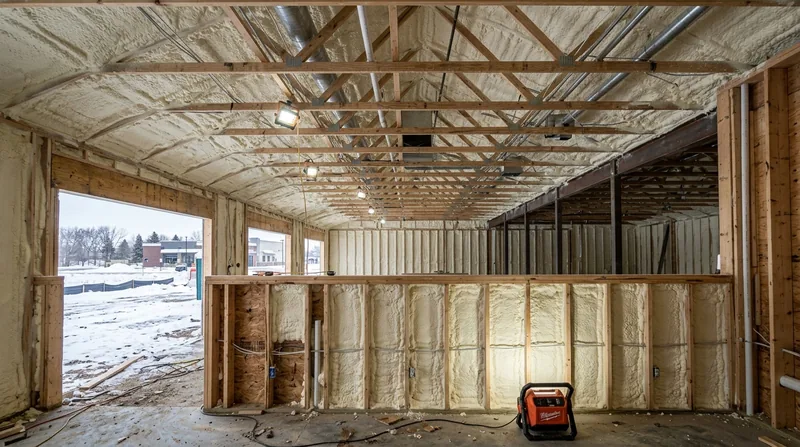




New construction and commercial projects across Hennepin and Washington counties benefit from a commercial and new construction spray foam envelope that goes in before drywall closes the walls and roof decks. In Minneapolis, where winters push temperatures well below zero and humidity swings from dry indoor air in January to wet summer storms, a tight thermal and air barrier built into the structure itself pays dividends from day one. We spray foam walls and roof decks on new builds and commercial shells across the Twin Cities metro, sealing the building envelope so mechanical systems don't have to fight air leaks, condensation risk, or thermal bridging through rim joists and roof penetrations.
Why Commercial and New Construction Spray Foam Matters in Minneapolis
New construction is the moment to get the envelope right. Unlike retrofit work, where we remove old insulation and navigate existing framing, new builds and commercial shells offer a clean substrate and full access before interior walls and systems go in. Spray foam applied to studs, band joists, and roof decks before drywall creates a continuous thermal and air barrier that fiberglass batts and blown-in cellulose cannot match. In Minneapolis' IECC climate zone 6A, that matters: a tight envelope means lower heating loads in winter, fewer ice dams along the eaves, less condensation at cold rim joists, and a building that breathes moisture outward in a controlled way rather than trapping it at the boundary.
- We spray open cell foam on walls and roof decks where vapor permeability is desired and cost is a priority.
- We spray closed cell foam where moisture control, high R-value per inch, and structural support are required.
- We seal all penetrations, top plates, and band joists before the foam sets, eliminating the air leakage paths that plague fiberglass-insulated buildings.
- We work from the framing stage through cure, coordinating with your schedule so mechanical and electrical trades can proceed without delay.
A properly insulated and sealed new building in Minneapolis reduces heating and cooling loads, improves indoor air quality by controlling infiltration, and avoids the condensation failures that plague older, poorly sealed homes in Northeast Minneapolis and along the Chain of Lakes.
Key info: New construction in Bloomington, Edina, and Maple Grove frequently includes metal stud commercial shells and mixed-use buildings where condensation control on steel roof decks is non-negotiable. Closed cell spray foam applied during framing prevents the rust and moisture damage that would otherwise require costly repairs before occupancy.
For guidance on what your local building department requires, check the Minneapolis permit and inspection office, which administers the energy and building code for your address.
How We Spray Foam Commercial and New Construction Projects in Minneapolis
Our process begins with a site walkthrough during framing, before drywall and mechanical systems are in place. We assess the substrate, identify penetrations and thermal bridges, confirm foam type and thickness with your builder or mechanical engineer, and schedule the spray to fit your construction timeline. Once foam is applied, we allow the specified cure time before trades resume work. The entire process is coordinated and documented so your project stays on schedule and every square foot meets code.
- We inspect the framing substrate for moisture, debris, and damage before any foam is applied.
- We spray walls, rim joists, and roof decks to the specified thickness and R-value, using either open cell or closed cell depending on your design and local code requirements.
- We provide mechanical ventilation during cure to manage off-gassing and ensure a safe re-entry window of twenty-four to forty-eight hours.
- We document coverage, thickness, and R-value on site so your inspector and mechanical contractor can verify the work against the plans.
- We stay in communication with your general contractor so the next trade can begin as soon as cure is complete.
A commercial office building in St. Paul or a new residential construction in Plymouth follows the same disciplined process: substrate prep, foam application, cure management, and documentation that holds up to inspection and warranty claims alike.
Example: A barndominium retrofit or new metal building in Washington County requires closed cell foam on the roof deck to prevent condensation on the steel substrate during winter. We spray it during the framing stage, cure it properly, and provide the thickness and R-value documentation your mechanical engineer needs to sign off on the thermal envelope before drywall and HVAC rough-in begin.
For more detail on how foam types compare, see our guide to closed cell spray foam insulation and open cell spray foam insulation.
Spray Foam Methods for New Construction and Commercial Work
| Approach | Description | Best for |
|---|---|---|
| Open Cell Spray Foam | Low-density foam that expands fully and remains slightly flexible. R-value of 3.5 to 3.7 per inch. Vapor permeable, allowing moisture to dry toward the exterior in winter and inward in summer. | New residential construction and interior walls where cost is a factor and vapor control is not critical. Sound dampening in commercial interiors. |
| Closed Cell Spray Foam | High-density foam with closed cells that block moisture. R-value of 6 to 7 per inch. Provides structural support and vapor barrier in one pass. More expensive per board foot but requires less thickness. | Metal building roof decks, steel-frame commercial shells, band joists, and any application where moisture control and high R-value per inch are non-negotiable. |
| Rim Joist and Band Joist Sealing | Closed cell foam applied to the rim joist, band joist, and rim band to seal the boundary between foundation and floor frame. Blocks air infiltration and condensation paths. | New construction where the rim joist is exposed during framing. Retrofit of older homes in Minneapolis where condensation at the rim is a chronic problem. |
| Roof Deck and Attic Sealing | Spray foam applied to the underside of roof decking or on the attic floor, sealing all penetrations, top plates, and eaves. Prevents air leakage and thermal bridging through the roof assembly. | New residential and commercial construction where a sealed attic or vented attic with a sealed roof deck is specified by the mechanical engineer. |
Commercial and New Construction Spray Foam Cost in Minneapolis: What to Expect
Pricing for spray foam on new commercial and residential construction depends on the foam type, thickness required by code, total board footage, substrate condition, and access. A free commercial estimate is your starting point. We visit the site during framing, measure the wall and roof areas, confirm the R-value and thickness with your engineer or architect, and provide a detailed quote that includes material, labor, and documentation.
Open cell foam costs less per board foot but requires more thickness to reach the same R-value as closed cell. Closed cell is more expensive per board foot but delivers higher R-value per inch, so a 2-inch closed cell application on a metal roof deck may cost less overall than 4 inches of open cell. New construction allows us to spray efficiently before drywall and HVAC obstruct the framing, which keeps labor costs reasonable compared to retrofit work.
Factors that affect the final cost include the total square footage of walls and roof decks, the foam type and required R-value, whether the substrate is clean and accessible, and the complexity of penetrations and thermal bridges. A straightforward new residential build in Edina or Bloomington will cost less per board foot than a commercial shell with exposed steel joists, multiple roof levels, and mechanical chases that require precision sealing.
Get at least two estimates so you can compare foam type, thickness, R-value, and price side by side. Ask each contractor for a written estimate that specifies the foam type, R-value per inch, target thickness, total board footage, and labor cost. Our pricing page provides a range for different project types. Call (612) 441-5734 for a free estimate with no obligation to book.
What to Look for When Hiring a Commercial and New Construction Spray Foam Contractor Near Minneapolis
Spray foam is a technical trade, and the difference between a professional installation and a careless one shows up in the first heating season. When you call a contractor for a quote, verify that they provide a written estimate with R-value and thickness specified, not just a price per board foot or a vague range. Ask whether they provide mechanical ventilation during cure and what re-entry window they recommend. Check that their insurance is current and that they can provide a certificate of insurance on request.
A professional contractor will ask about your local building code and permitting requirements, not assume they know. Minneapolis, St. Paul, Bloomington, and the surrounding cities each have their own building official and code enforcement, so any contractor who claims to know what your address requires without checking is cutting corners. We help you navigate what applies at your location and coordinate with your inspector so the work passes the first time.
Ask for references from recent new construction projects in your area. A contractor who has done work in Maple Grove, Woodbury, or Eagan can speak to the local building departments and their expectations. If the contractor cannot provide references or hesitates to share documentation of past work, look elsewhere.
- Verify that the contractor is fully insured and can provide a current certificate of insurance before work begins.
- Get a written estimate that specifies foam type, R-value per inch, target thickness in inches, and total board footage, not a price per board foot alone.
- Confirm that the contractor uses mechanical ventilation during cure and specifies a re-entry window of twenty-four to forty-eight hours, not immediate re-entry.
- Ask whether the contractor will coordinate with your general contractor and building inspector, and whether they provide documentation of coverage and thickness for the permit file.
- Check that the contractor is willing to walk away if the substrate is wet, contaminated, or not ready for foam, rather than spray over a problem.
A local contractor with a Minneapolis address, local insurance, and a track record on new construction in Hennepin and Washington counties is your best choice. Contact us at https://minneapolis-spray-foam.com/contact/ or call (612) 441-5734 for a free estimate and references from recent new construction projects in your area.
Commercial & New Construction Spray Foam in Minneapolis: Pricing Guide
| Service | Price | Details |
|---|---|---|
| Free commercial estimate | Free | Site visit during framing, substrate assessment, foam type and thickness review with your engineer |
| Open cell spray foam on walls | Starting at $0.50 per board foot | Material and labor, includes mechanical ventilation during cure and documentation for permit file |
| Closed cell spray foam on roof decks | Starting at $1.25 per board foot | Material and labor, includes mechanical ventilation, cure management, and R-value documentation |
| Rim joist and band joist sealing | Starting at $3.50 per linear foot | Closed cell foam applied to rim and band, includes air sealing and moisture barrier in one application |
| Complex new construction or metal buildings | On estimate | Multiple roof levels, exposed steel, complex penetrations, and thermal bridges require site assessment before pricing |
| Estimate response | Free | Call (612) 441-5734, response within 24 hours, no obligation to book or proceed |
Indicative pricing, the exact cost depends on square footage, finish, and site access. Free personalized estimate within 24h at (612) 441-5734.


