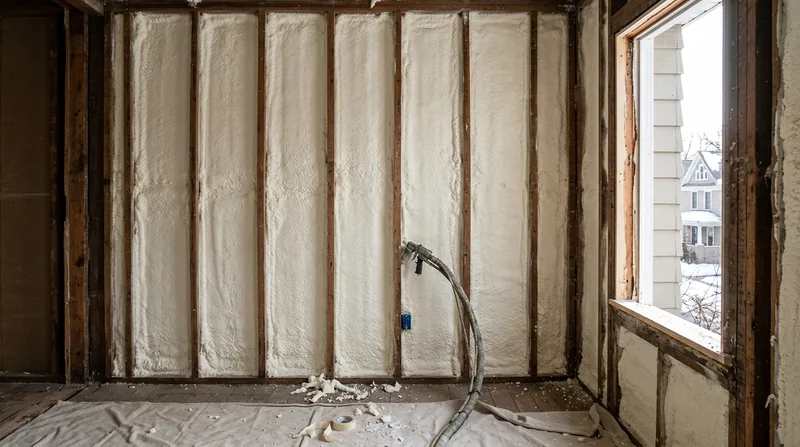




Open cell spray foam insulation in Minneapolis fills stud bays and attic cavities with a softer, lower-density foam that expands to seal gaps around wiring, framing, and mechanical penetrations. In Minneapolis homes, from pre-war Northeast duplexes to mid-century ramblers in Richfield and newer builds across Anoka and Dakota counties, open cell foam cuts winter drafts through the dry indoor air and adapts to the seasonal vapor swings of IECC climate zone 6A. Unlike closed cell foam, open cell is breathable, cost-effective for attic work where high R-value per inch is not the constraint, and quiets sound transmission between floors and from outside. We have been installing spray foam insulation since 2010 across Hennepin, Ramsey, and the surrounding counties, and we size each job to the actual failure mode: flattened attic insulation, uninsulated wall cavities in older duplexes, and cold rim joists where the foundation meets the band board are where open cell delivers the most value. This page covers what open cell foam is, where it works best in your home, what the process looks like, and how to compare estimates from local contractors.
Why Open Cell Spray Foam Matters in Minneapolis Homes
Minneapolis winters are long and cold, and the heating season runs from October through April. Heat escapes through three weak points in most homes: the attic floor and top plates (where decades-old fiberglass has settled flat), uninsulated wall cavities (especially in Northeast duplexes and pre-war stock), and the rim joist where the foundation meets the band board. Open cell foam fills these voids completely, eliminating the air gaps that fiberglass batts leave behind, and it does so at a lower cost per board foot than closed cell foam. The Minneapolis building code requires a thermal barrier (typically drywall) over spray foam in certain applications, and we follow the code in force at your address. The seasonal vapor drive in zone 6A, outward during winter, inward during humid summers, makes air sealing around foam the critical detail, and that is what separates a job that lasts from one that fails.
- Open cell foam expands to fill stud bays, around electrical boxes, and into the corners where fiberglass leaves gaps.
- A typical attic application in a Minneapolis rambler costs less than closed cell and delivers R-3.5 to R-4 per inch of thickness.
- Open cell is breathable, which means it allows moisture vapor to pass through, reducing the risk of condensation in wall cavities during the winter vapor drive.
- The material is applied in controlled passes, with mechanical ventilation during cure, and a re-entry window of 24 to 48 hours before occupancy.
- We remove old insulation first if it is settled, contaminated, or blocking the work area, and we air-seal all penetrations before foam is sprayed.
Getting a written estimate with R-value and thickness specifications is the first step; a contractor who quotes a price without those details is cutting corners.
Key info: Minneapolis building codes require a thermal barrier (typically 1/2-inch drywall) over spray foam in attics and walls, and a 15-minute ignition barrier in some applications. The building official at your city or township governs what applies at your address, not the foam manufacturer or the installer. Always confirm code requirements with your local building department before work begins.
For more on how attic insulation and air sealing work together, see our attic spray foam insulation page. You can also verify Minneapolis building code requirements at the Minneapolis Building Permits office.
How We Install Open Cell Spray Foam Insulation in Minneapolis
The installation process starts with a site visit to assess the current insulation condition, air leaks, moisture sources, and the scope of work. We measure the area, identify any settling or contamination, and plan the foam application in controlled passes to meet the manufacturer ratio and drum temperature. Mechanical ventilation runs during cure and for the stated re-entry window (typically 24 to 48 hours), and we do not allow occupancy until that window closes. If the existing insulation is flattened, wet, or contaminated, we remove it first, that is the precondition of a sound retrofit. Once the substrate is clean and dry, we spray open cell foam to the specified thickness, which is marked and documented in the written estimate.
- We inspect the attic or wall cavity for moisture, settling, and air leaks before any foam is applied.
- Old insulation is removed and disposed of if it is blocking the work area or if the homeowner requests a full retrofit.
- All major penetrations (vents, flues, wiring) are sealed with foam or caulk before the main application.
- Open cell foam is sprayed in multiple passes to the specified thickness, typically 3.5 to 6 inches in an attic.
- Mechanical ventilation and air circulation maintain proper cure conditions throughout the application window.
- We document the R-value, thickness, and coverage area in a written record provided to the homeowner.
The entire process is transparent: you receive a written estimate before work begins, and we walk you through the timeline and re-entry requirements before the crew arrives.
Example: A 1,200-square-foot attic in a St. Louis Park rambler with 4 inches of settled fiberglass takes about two days: one day for removal and prep, one day for foam application and cure setup. A Northeast Minneapolis duplex with uninsulated wall cavities in a second-floor bedroom takes one to two days depending on access and the number of bays. The re-entry window is 24 to 48 hours; we specify this in writing and confirm it with the homeowner before leaving the site.
For details on wall cavity insulation and how it compares to closed cell foam, see wall and injection foam insulation.
Open Cell Spray Foam Insulation Methods and Applications
| Approach | Description | Best for |
|---|---|---|
| Attic Top-Up | Spray 3 to 6 inches of open cell foam over existing settled fiberglass or mineral wool to bring the attic to code R-value. | Attics in Richfield, Edina, and St. Louis Park where the existing insulation is sound but compressed. |
| Full Attic Retrofit | Remove old insulation completely, air-seal all penetrations, then spray open cell foam to R-30 or R-38 depending on code and climate. | Older homes in Northeast Minneapolis with flattened or contaminated insulation and high heating bills. |
| Wall Cavity Fill | Spray open cell foam into uninsulated stud bays in exterior walls, filling around wiring and framing without demolition. | Pre-war duplexes and single-family homes in Nokomis and around the Chain of Lakes with hollow walls. |
| Rim Joist and Band Board | Seal the rim joist with open cell foam to block cold air infiltration where the foundation meets the band board. | Basements in Minneapolis and surrounding counties where condensation forms on the rim joist in winter. |
| Garage Ceiling | Spray open cell foam on the underside of the garage roof or ceiling to reduce heat loss and noise from the space above. | Attached garages in Bloomington, Plymouth, and Maple Grove where the ceiling is uninsulated. |
Each method is tailored to the building, the climate, and the homeowner's goals. We specify the approach in the written estimate and confirm it with the homeowner before work begins.
Open Cell Spray Foam Insulation Cost in Minneapolis: What to Expect
Open cell spray foam insulation in Minneapolis typically costs from $0.55 per board foot as a starting point, with the final price depending on the area to be covered, the thickness required by code, site access, and whether old insulation needs to be removed first. A small attic top-up in a Richfield home might run $1,500 to $3,000, while a full attic retrofit with removal in a larger Northeast Minneapolis duplex could be $4,000 to $8,000 or more. Wall cavity fill in a pre-war home is priced by the linear foot and the number of bays, and rim joist sealing is typically a smaller scope at $500 to $1,500 depending on the length of the foundation perimeter. The only way to know what your job will cost is to request a free written estimate with R-value and thickness specifications; a contractor who quotes over the phone without measuring is guessing.
- Board footage is measured on site at the time of the estimate, based on the area and the specified thickness.
- Removal of old insulation adds cost but is necessary if the existing material is settled, contaminated, or blocking the work area.
- Access, attic condition, and the presence of mechanical systems (ducts, vents, flues) affect the application timeline and final price.
- Travel is included in our pricing for Minneapolis and the surrounding service area; no separate mileage fee or call-out charge.
- A written estimate is free and comes with no obligation to book the job.
Getting two or three estimates from local contractors allows you to compare not just price but also the thickness, R-value, and scope of work each one proposes. For a detailed pricing overview and to request your free estimate, visit our pricing page or call us at (612) 441-5734.
What to Look for When Hiring a Spray Foam Insulation Contractor Near Minneapolis
Hiring a local spray foam contractor is a significant decision, and there are real differences between a careful, insured operator and a rig-and-run crew that sprays a job in an afternoon and disappears when the smell will not go away. The Minneapolis area spans multiple cities and townships, each with its own building code, permitting rules, and contractor registration requirements. Start by asking any contractor for proof of current insurance coverage; a reputable operator will provide a certificate of insurance without hesitation. Request a written estimate with R-value and thickness specifications, not a vague price range. Check references from recent jobs in your neighborhood, Bloomington, Brooklyn Park, Eden Prairie, and other suburbs have different code requirements, so local experience matters. Ask about the re-entry window and mechanical ventilation during cure; if a contractor promises immediate re-entry or skips ventilation to save time, walk away.
- Verify that the contractor carries current, verifiable insurance and can provide a certificate on request.
- Request a written estimate with the R-value per inch, the total thickness in inches, and the board footage.
- Ask for references from jobs completed in the last 12 months in your city or township.
- Confirm that the contractor understands the building code in force at your address and will follow the thermal barrier and ignition barrier rules.
- Ask about the cure timeline, mechanical ventilation during application, and the stated re-entry window (typically 24 to 48 hours).
- Get clarity on whether old insulation removal is included in the estimate or priced separately.
A contractor who dodges questions about insurance, gives you a price without measuring, or promises faster re-entry than the manufacturer specs allows is not the one to hire. We are fully insured, we provide written estimates with full specifications, and we follow the code at your address. Call us at (612) 441-5734 or request a free estimate online.
Open Cell Spray Foam Insulation in Minneapolis: Pricing Guide
| Service | Price | Details |
|---|---|---|
| Attic Top-Up | Starting at $0.55/board ft | Spray 3 to 6 inches of open cell foam over existing insulation, cost driven by attic size and thickness required |
| Full Attic Retrofit | Starting at $0.60/board ft | Remove old insulation, air-seal penetrations, spray to R-30 or R-38, cost increases with removal volume and attic condition |
| Wall Cavity and Rim Joist Fill | Starting at $0.65/board ft | Smaller scopes priced by linear foot or bay count, access and wall configuration determine final cost per board foot |
| Garage Ceiling or Complex Retrofit | On estimate | Scope requires on-site measurement and assessment of access, existing conditions, and code requirements before pricing |
| Insulation Removal | Included or separate | Quoted separately if old material is extensive, contaminated, or requires specialized handling and disposal |
| Free Written Estimate | No charge | Includes R-value, thickness, board footage, and scope detail, response within 24 hours at (612) 441-5734 |
Indicative pricing, the exact cost depends on square footage, finish, and site access. Free personalized estimate within 24h at (612) 441-5734.


