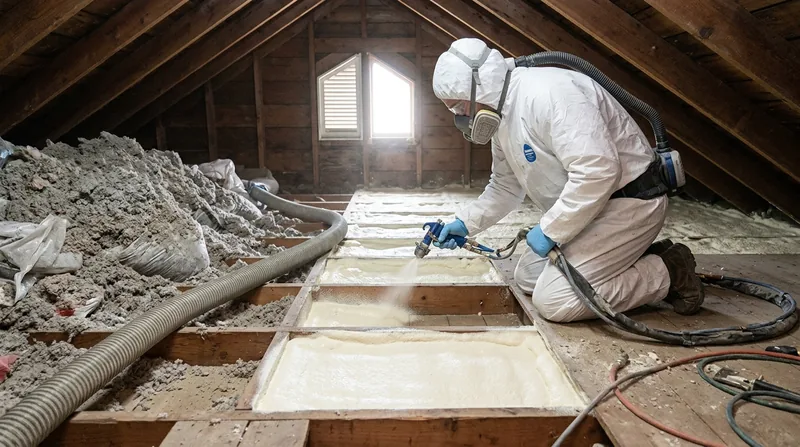




Insulation Replacement & Re-Insulation in Minneapolis addresses a problem that compounds every winter: old insulation settles flat, loses its R-value, and lets heated air escape through attic floors and into the rim joists where basement block walls meet the rim band. Minneapolis homes from the 1920s bungalows in Northeast and Longfellow to the mid-century ramblers in Richfield and Edina all sit over full basements, and nearly every one of them has either deteriorated attic insulation or uninsulated wall cavities that push heating bills higher each season. In zone 6A, with long cold winters and the seasonal vapor drive that reverses between heated indoor air in winter and humid summer storms, removing failed insulation and replacing it with fresh foam sized for your home's actual needs is the most direct path to stable indoor temperatures and lower energy costs. We remove old material, air seal around penetrations, and install closed cell or open cell spray foam to the R-value and thickness your Minneapolis address requires. Let's walk through what the job entails, why timing matters in this climate, and how to choose the right contractor.
Why Insulation Replacement Matters in Minneapolis Homes
Settled fiberglass, deteriorated cellulose, and ancient rock wool are the three culprits that drive up heating costs in older Minneapolis housing stock. When insulation compacts, it loses its air pockets, and air pockets are what create the R-value. A 12-inch layer of fiberglass that was R-38 when installed thirty years ago may perform at R-20 or lower today. The problem is worst in attics, where gravity and seasonal temperature swings work against you, but uninsulated wall cavities in pre-war duplexes around Northeast Minneapolis are equally costly. Rim joists and band joists where the basement rim meets the foundation wall are the other weak point: cold block or stone conducts temperature directly into the heated space above, and moisture from the basement can condense on the foam or the rim itself if the substrate is not sealed and dried first.
- Attic insulation that has settled to half its original thickness lets winter heat escape and allows ice dams to form along the eaves each season.
- Open wall cavities in older Minneapolis homes remain uninsulated because blown-in fiberglass cannot reach them without demolition, and spray foam can.
- Rim and band joists conduct cold directly into the house and are a moisture risk if the basement is damp or has had any history of water entry.
- Failed insulation replacement is the single largest driver of energy waste in the Minneapolis metro, and the only permanent fix is removal and re-insulation with material that will not settle.
Replacing old insulation is not optional maintenance in zone 6A; it is the foundation of winter comfort and the clearest way to lower what you pay to heat your home.
Key info: The Minnesota Building Code and local energy code govern attic ventilation, ignition barriers, and thermal barriers. Verify what applies at your address by contacting your city building department; requirements differ between Minneapolis, St. Paul, Bloomington, and other jurisdictions, and there is no statewide reciprocity.
For more detail on what failed insulation looks like and how we assess it, see our page on Insulation Removal.
How We Handle Insulation Replacement & Re-Insulation in Minneapolis
The process starts with a complete removal of old material, followed by inspection and air sealing of the substrate, and finishes with fresh foam applied to the thickness and R-value your home requires. We do not spray over old insulation, old vapor barriers, or wet substrates. If moisture is present, we identify the source and either address it or refer you to the appropriate contractor. Once the substrate is clean and dry, we apply closed cell or open cell spray foam in controlled passes, maintaining manufacturer ratio and drum temperature, with mechanical ventilation running during cure. Re-entry is safe after twenty-four to forty-eight hours, depending on foam type and ambient conditions.
- We remove all old insulation, debris, and any damaged vapor barrier or drywall by hand and hauling, leaving a clean substrate for inspection.
- We seal air leaks around electrical penetrations, pipe chases, rim joists, and other bypasses with foam or caulk before applying the primary insulation layer.
- We apply spray foam to the thickness and R-value specified in the estimate, measured in board feet and confirmed by visual inspection and documentation.
- We provide a written estimate that names the R-value, thickness in inches, foam type, and board-foot volume before any work begins.
Every job is measured and documented on site, so the estimate you receive reflects the exact scope of your home.
Example: A 1,200-square-foot attic in a Richfield rambler with settled R-19 fiberglass receives removal and replacement with R-49 closed cell foam. A Northeast Minneapolis duplex with open wall cavities gets injection foam into the wall bays after removal of any old material. A St. Louis Park basement rim joist with condensation risk gets sealed, dried, and covered with closed cell foam to control moisture and temperature.
For more on the air sealing process and how it works alongside insulation, see Air Sealing in Minneapolis.
Insulation Replacement Methods and Materials
| Approach | Description | Best for |
|---|---|---|
| Attic Removal & Closed Cell Foam | Complete removal of old fiberglass or cellulose, substrate inspection, air sealing, and application of closed cell foam to R-49 or higher. | Attics with settled insulation, ice dam history, or moisture concerns; highest R-value per inch. |
| Wall Cavity Injection Foam | Low-pressure injection of closed cell or open cell foam into existing wall cavities without drywall removal. | Pre-war duplexes and older Minneapolis homes with uninsulated walls; retrofit without demolition. |
| Rim & Band Joist Sealing | Removal of old or failed insulation, substrate drying and sealing, then closed cell foam application to the rim and band joist. | Basements with cold rim joists, condensation, or past water entry; entry-level re-insulation project. |
| Open Cell Attic Top-Up | Application of open cell foam over existing sound insulation to raise R-value without full removal. | Attics where old insulation is compacted but substrate is intact; cost-effective upgrade when demolition is not required. |
| Crawl Space Encapsulation & Foam | Removal of old insulation, substrate preparation, and closed cell foam application to rim joists and band joists in the crawl space. | Crawl spaces with moisture history or failed insulation; improves basement temperature stability. |
Insulation Replacement & Re-Insulation Cost in Minneapolis: What to Expect
Insulation replacement costs in Minneapolis start at $2,800 for small projects like a rim joist or a single-room attic top-up, and scale upward based on the square footage of the space, the R-value target, the type of foam, and the complexity of substrate preparation. A full attic removal and replacement in a 1,200-square-foot space with closed cell foam will run higher because of the labor to haul old material and the board-foot volume required to reach R-49 or higher. Wall cavity injection is priced per board foot and per linear foot of wall, so an uninsulated 1,500-square-foot first floor in an old duplex costs more than a 600-square-foot basement rim joist. Access, substrate condition, and whether moisture remediation is needed all move the final number. Crawl spaces with water damage history or failed vapor barriers require more prep work and cost more. The best way to know your actual cost is to request a free written estimate that names the R-value, thickness, foam type, and board-foot volume, and to get 2 to 3 estimates so you can compare scope and pricing side by side.
See our pricing page for typical ranges and what drives cost in each category.
Insulation Replacement & Re-Insulation Near Me: What Minneapolis Homeowners Should Know When Hiring
Hiring the right contractor for insulation replacement is about verifying three things: that the contractor is fully insured and carries current liability coverage, that the estimate is detailed and includes R-value and thickness, and that references are real and recent. Many contractors in the Minneapolis area are rig-and-run outfits that spray in an afternoon and disappear; others are national franchises with limited local knowledge of zone 6A moisture and ice dam problems. A local independent contractor with a local address and a track record in Minneapolis, St. Paul, Bloomington, and the surrounding metro should be able to explain why closed cell is right for your attic or why open cell makes sense for your walls, and should be willing to provide a written warranty on the workmanship and a contact number for questions after the job is done.
- Ask any contractor you interview to provide proof of current liability insurance and the name of their insurance carrier, so you can verify coverage.
- Request a detailed written estimate that names the R-value, foam type, thickness in inches, and total board feet, not just a price per square foot.
- Get at least 2 other estimates from contractors in the Minneapolis area and compare the scope and the reasoning for their material choice.
- Check references from jobs completed in the past 12 months in your neighborhood or a similar home type, and call them to ask about smell, re-entry time, and follow-up support.
- Verify that the contractor understands local building code for attic ventilation, thermal barriers, and ignition barriers by asking them what applies at your specific address; if they give a one-size-fits-all answer, that is a red flag.
A contractor who can explain the seasonal moisture risk in Minneapolis basements and the ice dam problem in older attics is demonstrating the local expertise that matters most.
Call us at (612) 441-5734 for a free estimate, or visit our contact page to request one online. We respond within 24 hours and can discuss your specific home type and what re-insulation will cost.
Getting Started With Insulation Replacement in Minneapolis
The first step is a phone call or a form submission with photos of the space you want to re-insulate. We ask about the age of the home, the current insulation type, whether you have seen condensation or ice dams, and what your heating bills have looked like. From there, we schedule an on-site visit to measure the space, inspect the substrate, and identify any air leaks or moisture issues. The estimate we provide is written and detailed, and includes a timeline and a workmanship warranty. If you approve, we schedule the removal and installation at a time that works for your schedule. The job is typically complete in one to three days depending on size, and you can re-enter the space within 24 to 48 hours after the foam has cured.
We serve Minneapolis, St. Paul, Bloomington, Brooklyn Park, Plymouth, Maple Grove, Woodbury, Eagan, Eden Prairie, Coon Rapids, Burnsville, Minnetonka, Apple Valley, Edina, St. Louis Park, Richfield, Roseville, Blaine, Lakeville, Shakopee, and the surrounding Hennepin, Ramsey, Dakota, Anoka, and Carver counties. Call (612) 441-5734 or contact us online to request your free estimate today.
Insulation Replacement & Re-Insulation in Minneapolis: Pricing Guide
| Service | Price | Details |
|---|---|---|
| Rim Joist & Band Joist Re-Insulation | Starting at $2,800 | Removal, substrate inspection, and closed cell foam application to basement rim and band joists in one or two bays. |
| Attic Insulation Removal & Replacement | Starting at $4,500 | Complete removal of old fiberglass or cellulose, air sealing, and closed cell foam to R-49 in attics 800 to 1,200 square feet. |
| Wall Cavity Injection Foam Retrofit | Starting at $3,200 | Low-pressure injection of foam into uninsulated wall cavities in pre-war Minneapolis duplexes and older homes without drywall removal. |
| Large Attic or Multi-Space Project | On estimate | Attics over 1,500 square feet, crawl spaces with moisture history, or whole-house re-insulation require on-site measurement and detailed scope. |
| Travel & Service Call | Included | No mileage fee or separate travel charge in Minneapolis and surrounding metro counties; included in the estimate. |
| Free Written Estimate | Free | Detailed scope with R-value, thickness, foam type, and board feet specified; response within 24 hours at (612) 441-5734. |
Indicative pricing, the exact cost depends on square footage, finish, and site access. Free personalized estimate within 24h at (612) 441-5734.


