Understanding Your Minneapolis Attic's Current State
Before deciding whether to add more insulation to your Minneapolis attic or invest in a complete spray foam retrofit, you need to understand what's already up there. Many homes in the Twin Cities area were built with fiberglass batts or blown-in cellulose that has settled over decades, leaving gaps and compressed sections that no longer perform at their rated R-value. The cold Minnesota winters make attic insulation performance critical for both comfort and energy bills.
A professional energy audit can reveal exactly what you're working with. Some homeowners discover their existing insulation is doing less than half the job it was designed to do. Others find that while the insulation depth looks adequate, air leaks around penetrations, ductwork, and the attic perimeter are the real culprits behind heat loss. Understanding this distinction is key to choosing the right solution for your home.
What Is Air Sealing and When Is It Enough?
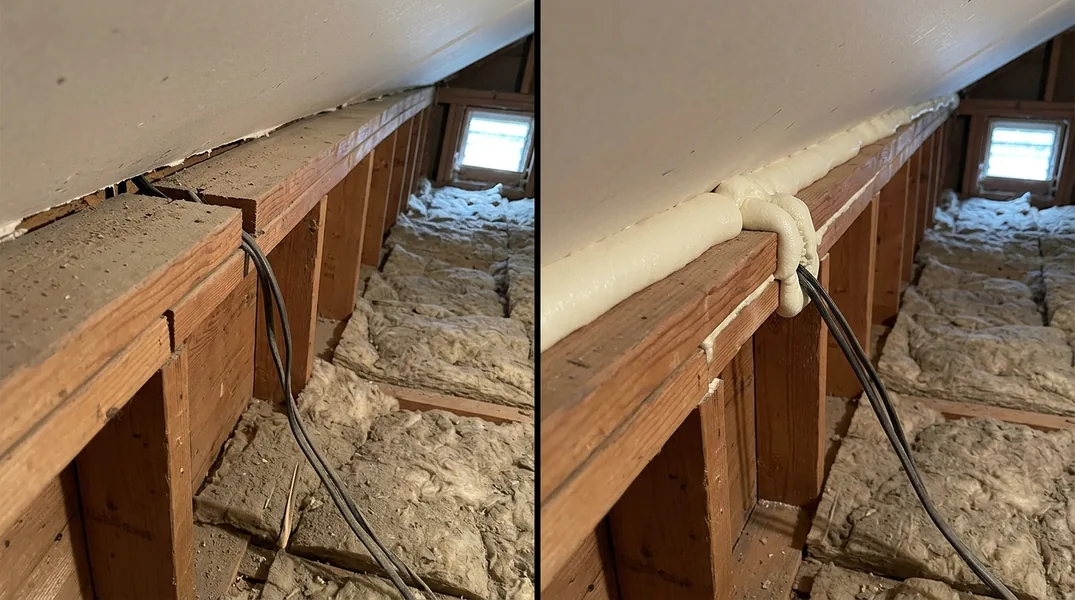
Air sealing is the process of identifying and closing air leaks in your attic without necessarily adding new insulation material. Common leak points include gaps around electrical boxes, plumbing vents, recessed lights, attic access hatches, and the rim joist where the attic meets exterior walls. Using caulk, weatherstripping, and foam sealant, contractors can dramatically reduce the amount of conditioned air escaping into your attic and then to the outdoors.
For many homeowners, air sealing alone can provide meaningful energy savings, sometimes reducing heating costs by 10 to 15 percent. If your existing insulation is already at or near the recommended R-value for Minnesota, air sealing may be all you need. However, if your insulation is thin, compressed, or missing in patches, topping it up with additional material becomes necessary. The question then becomes whether to add more traditional insulation or upgrade to Attic Spray Foam Insulation, which seals and insulates simultaneously.
R-Value Requirements by State and Minneapolis Standards
Minnesota building codes and the U.S. Department of Energy recommend an attic R-value of R-49 to R-60 for most homes in the Minneapolis area, depending on your specific heating degree days and climate zone. This accounts for the region's cold winters and the importance of keeping heat inside during the heating season. If your attic is currently at R-30 or R-38, you have a significant gap to close.
The R-value per inch varies by insulation type. Traditional fiberglass batts provide roughly R-3.2 to R-3.8 per inch, while blown-in cellulose offers about R-3.5 per inch. Closed Cell Spray Foam Insulation delivers approximately R-6 to R-7 per inch, meaning you need far less thickness to achieve the same thermal resistance. Open Cell Spray Foam Insulation provides around R-3.5 to R-3.6 per inch but offers superior air sealing properties and is more cost-effective than closed cell in many applications.
To determine how thick spray foam should be for your attic, divide your target R-value by the R-value per inch of your chosen foam type. For example, reaching R-49 with closed cell foam requires roughly 7 to 8 inches, while open cell would need about 13 to 14 inches. This thickness difference affects both material costs and installation time, making it essential to understand your options before committing to a solution.
Air Sealing Plus Topping Up: A Middle-Ground Approach
Many homeowners in St. Paul and surrounding areas find success with a hybrid strategy. First, seal all major air leaks with caulk, weatherstripping, and foam sealant. Then, add blown-in insulation or a thin layer of spray foam on top of existing batts to bring the total R-value closer to code. This approach costs less than a full spray foam retrofit while still addressing both air leakage and thermal resistance.
The downside of this middle approach is that it doesn't provide the long-term durability and performance consistency of a complete spray foam system. Blown-in insulation can settle and compress over time, and air sealing materials may degrade. Additionally, you're not getting the air barrier benefit throughout the entire attic if you're only spraying a thin layer over existing fiberglass. However, if your budget is tight and your current insulation isn't severely compromised, this strategy can extend the life of your attic system by 5 to 10 years.
When Full Spray Foam Insulation Makes Sense
Full Attic Spray Foam Insulation is the premium solution and becomes the better choice when your existing insulation is heavily degraded, missing in large sections, or when your attic has complex geometry with many penetrations. Spray foam creates a seamless air barrier while simultaneously providing insulation, eliminating the need for separate air sealing steps. It adheres to rafters, joists, and irregular surfaces, ensuring no gaps are missed.
The long-term performance advantage is significant. Spray foam doesn't settle, compress, or lose effectiveness over time like traditional insulation. It also resists moisture intrusion and pest infiltration better than fiberglass or cellulose. While the upfront cost is higher, the durability and energy savings often justify the investment over a 20 to 30 year lifespan. For homeowners planning to stay in their Minneapolis home long-term, full spray foam typically delivers the best return on investment.
Attic Spray Foam Insulation Cost in Minneapolis: What to Budget
Understanding pricing for attic insulation projects helps you make an informed decision. Air sealing alone typically costs between $500 and $2,000, depending on the number and complexity of leak points. Adding blown-in insulation to top up an attic might run $1,500 to $4,000 for an average 1,200 square foot attic. Full spray foam insulation generally ranges from $4,000 to $10,000 or more for the same space, depending on foam type and thickness required.
The good news is that federal and state incentives can offset these costs. The federal insulation tax credit currently allows homeowners to claim up to $3,200 in energy efficiency improvements, including attic insulation and air sealing. Some utility companies in Minnesota also offer insulation rebates that can reduce your out-of-pocket expense. Additionally, investing in proper attic insulation can lower your heating bills by 10 to 25 percent, meaning the project often pays for itself within 5 to 10 years through energy savings alone.
To understand your specific costs and available incentives, contact Minneapolis Spray Foam Insulation at (612) 441-5734 or request a free estimate. A professional assessment of your attic will clarify whether air sealing alone, topping up, or full spray foam is the right fit for your home and budget.
Making Your Decision: Air Sealing, Topping Up, or Full Foam
The right choice depends on three factors: your current insulation R-value, the condition of existing materials, and your long-term plans for the home. If your attic is already at R-40 or higher and you only have minor air leaks, sealing those leaks may be sufficient. If you're at R-30 to R-40 with some degradation, topping up with blown-in insulation or a thin spray foam layer makes sense. If you're below R-30, have significant settling or moisture damage, or want the best performance and durability, full spray foam is the investment that pays dividends.
Don't let the decision paralyze you. Energy costs continue to rise, and every winter in Minneapolis represents lost money through an under-insulated attic. Whether you choose a modest air sealing project or a comprehensive spray foam installation, taking action now improves your home's comfort and efficiency. Reach out to Minneapolis Spray Foam Insulation today to discuss your specific situation and get a clear recommendation tailored to your attic's needs and your budget.
Looking for a professional spray foam insulation contractor in Minneapolis? Minneapolis Spray Foam Insulation responds fast for all your spray foam insulation needs.
Get a Free Quote